What is the Library of Congress?
Explainer
What is the Library of Congress?
On August 24, 1814, British troops occupying Washington set fire to the Capitol, and the congressional library lost its collection of about 3,000 books. The next year, 1815, Congress bought Thomas Jefferson's personal library of 6,487 books for $23,950. Those books are the foundation of the Library of Congress collection today. Then, in 1851, a fire destroyed about two thirds of them as well.
A library that twice lost its books to fire now calls itself "the largest library in the world." Its annual report for fiscal year 2023 put the collection at more than 178.2 million items. But it started out far smaller.
A library for lawmakers and justices
In 1800, when President John Adams signed the law moving the capital, Congress set aside $5,000 to buy books. What it gathered was reference material for Congress itself, and only members of Congress and justices of the Supreme Court could use it. The Library is still an agency of the legislative branch, serving as the research arm of Congress. It occupies three buildings on Capitol Hill in Washington, D.C.: the Thomas Jefferson Building, the John Adams Building and the James Madison Memorial Building.
From 1870, materials deposited for copyright began flowing into the Library, and the collection grew dramatically. In 1897 it moved into a building of its own.
Japan in Washington
Copyright deposits brought in more than books. Many of the Library's stereograph cards arrived the same way, and among its stereographs of other countries, views of Japan are especially numerous.
The Prints & Photographs Division also holds Japanese woodblock prints and hand-painted works, from the 17th century to the early 20th. Its greatest strengths are ukiyo-e and Yokohama-e, literally "pictures of Yokohama." The collection of the photographer Arnold Genthe adds photos he took in Japan in 1908, among them Itsukushima Shrine on the island of Miyajima.
The Library has collected Japanese-language publications, too. By its own account, this is the largest collection of them outside Japan. It grew out of an exchange of government publications that began in 1875, and a December 2010 issue of the Library's bulletin counted about 1.17 million items.
In December 1947, a mission that included the Library's Chief Assistant Librarian, V. W. Clapp, traveled to Japan. The plan that came out of its advice became the basis for the bill creating Japan's National Diet Library. You can follow that story in our article on the National Diet Library.
Seeing and using it from afar
You don't have to go to Washington to see these prints and photographs; you can look at them from Japan or anywhere else. That doorway is the Library of Congress website. The Library opens its collections widely as a contribution to education and scholarship, and anyone can browse the Prints & Photographs Division's catalog records and digital images online for free.
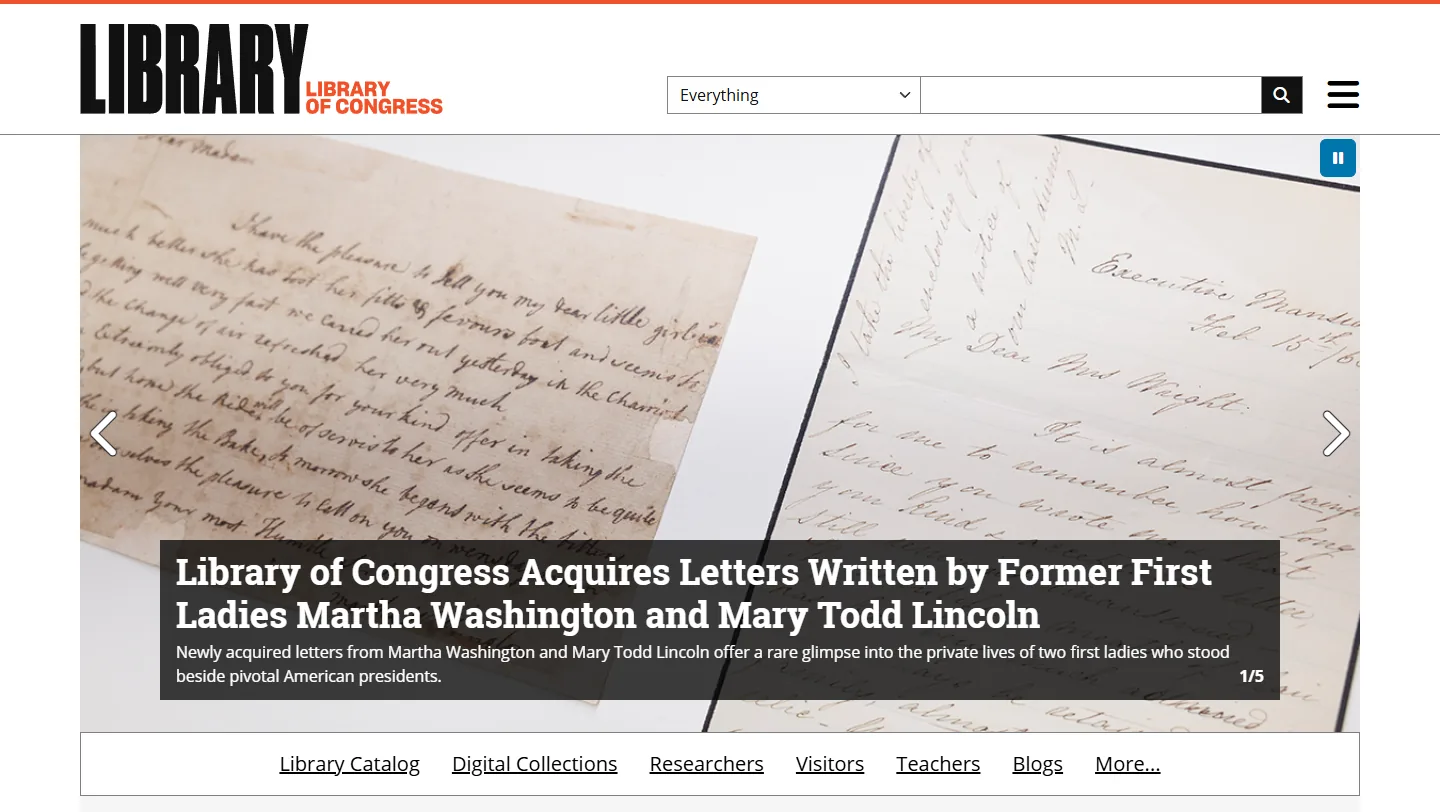
Source: Library of Congress website (https://www.loc.gov/), captured November 7, 2026
If you want to use an image, it helps to know how to read the rights statement "No known restrictions on publication." All it means is that the Library isn't aware of any restrictions. It is not a promise that the image is in the public domain and free of copyright.
The Library generally doesn't own the rights to the items in its collections. That's why it charges no fees for permission to use them, and why it can neither grant nor refuse permission to publish them. The Library explains that it's up to you, the user, to check for copyright, donor restrictions, privacy rights and the like, and to deal with whatever you find.
How it connects to 3rd-Party.jp
Being public isn't the same as being free to use. 3rd-Party.jp makes a point of showing that difference by citing the grounds and the source. From the Library of Congress, Kioku Kabegami brings in Japanese ukiyo-e, stereograph cards taken in Japan, postcards, and Genthe's photographs. We only use items the Library marks "No known restrictions on publication," and we check one by one that each has also passed out of copyright under Japanese law. On every photo page, the part that tells you whether you can use the image shows the Library's statement side by side with the fact that the Japanese copyright term has expired. We don't call these images public domain, because the Library doesn't. Our credits follow the Library's own credit line, too: "Source: Library of Congress," with the reproduction number in parentheses.
Sources
- LOC「Working at the Library」 (opens in a new tab)
- The Library of Congress: A Timeline (opens in a new tab)Library of Congress
- LOC「History and Background of the Library of Congress」 (opens in a new tab)
- Fascinating Facts (opens in a new tab)Library of Congress
- Thomas Jefferson's Library (opens in a new tab)Library of Congress
- LOC「Thomas Jefferson Library Collection: About the Collection」 (opens in a new tab)
- LOC「Our Mission」 (opens in a new tab)
- LOC「Annual Report of the Librarian of Congress, FY2023」 (opens in a new tab)
- LOC「Library of Congress Fact Sheet」(2016年) (opens in a new tab)
- LOC ブログ「Happy 225th Birthday, Library of Congress!」(2025年4月) (opens in a new tab)
- LOC「Visitor's Guide」 (opens in a new tab)
- LOC「Frequently Asked Questions」 (opens in a new tab)
- LOC「Prints and Photographs Online Catalog」 (opens in a new tab)
- LOC「Prints & Photographs Online Catalog」 (opens in a new tab)
- LOC「Fine Prints: Japanese, pre-1915 – About this Collection」 (opens in a new tab)
- LOC「Stereograph Cards – About this Collection」 (opens in a new tab)
- LOC「Stereograph File filing series」 (opens in a new tab)
- LOC「[Itsukushima Shinto Shrine, Japan]」 (opens in a new tab)
- LOC「Arnold Genthe in the mountains of Japan」 (opens in a new tab)
- LOC 研究ガイド「Japanese Collection」 (opens in a new tab)
- Asian Collections: Japanese Collection (opens in a new tab)Library of Congress research guide
- LOC「Looking to the East (December 2010)」 (opens in a new tab)
- History (Japanese) (opens in a new tab)National Diet Library
- Copyright and Rights and Restrictions Information (opens in a new tab)Library of Congress
- LOC 研究ガイド「Assessing the Risk of Using a P&P Image」 (opens in a new tab)